All Posts By

inbodyro

Increasing Gym Member Retention and Revenue with Body Composition

By Uncategorised

All the doom-and-gloom reports about global obesity may be having one positive outcome: more Americans are signing up for gyms every single year.  According to IHRSA, the number of memberships at health clubs of all types has increased by 31% to 54.1 million memberships from 2005 to 2014.

To account for this rise in demand, the number of registered health clubs has risen by 28.4% in the same period, contributing to what has become a $24.2 billion-dollar industry.

This should tell you two things:

  1. The industry is healthy and growing, with more people demanding quality gyms and health clubs today than ever before.
  2. The fitness space is becoming ever more crowded and competitive, meaning that attracting new members and membership retention has never been more critical for fitness centers than it is today.

In this crowded space, what can you do to remain competitive?

Sure, you can – and probably should –  hire personal trainers to help your members reach their goals.  You can also develop new programming and classes to diversify your clientele and reach out to new types of members.  Both of these are tried-and-true methods that have been proven to work in gyms all over the world.

But what’s something else you can offer that can increase member engagement and retention, while at the same time improve your training programs, improve your customer service, and make training more personal?  

Body composition analysis.

With body composition analysis, you will be able to tell your members exactly what all their hard work in your gym, working with your trainers, has resulted in: the pounds of muscle gained and/or fat lost– whatever their individual goals are.

Here are ways you can retain your members and increase revenue by implementing body composition analysis in every stage of the member cycle: attracting them, keeping them engaged, and retaining them over the long term.

#1 Improve Training/Coaching Quality

Nearly every gym, large and small, has personal trainers on staff if they can afford them.  It’s pretty much expected to have trainers if you plan to run a successful gym in a competitive marketplace. Small wonder that personal training is now a $10 billion-dollar industry.

Getting the right trainers with experience is one important hurdle, but giving them the resources they need to do their job is just as important.  That’s where body composition analysis can improve the quality of your trainers and coaches.

With a member’s body composition results in hand, you can give your trainers the data they need to design the workouts to meet a member’s goals, and then give them the proof to back it up later on.  This is especially important when two very different members come to you with a similar goal.  Do you treat them the same because they have the same goal?

For example, consider the ever-popular goal that goes something like: “I don’t really want to get big but just get toned.”

Any personal trainer worth their salt should be able to hear this and understand it as “I need some degree of muscle development coupled with some degree of fat loss.”  But how much of each does the new signup need?  Consider the body composition profiles of these two people and imagine both of them coming into the gym and saying they “want to just get toned.”

“C Shape”: Ends of Bars form a C

“I Shape”: Ends of Bars are aligned in an I

The first person’s body composition (C shape) is a pretty common example of someone who has not been exercising much – underdeveloped Skeletal Muscle Mass combined with excessive Fat Mass.

For this person to become “toned,” it would be wise to set them on a path that leads towards both muscle development and fat reduction.  Depending on this person’s goals, a trainer might advise them to focus on muscle development first through resistance/strength training, or the trainer could target Fat Mass reduction through some combination of cardiovascular/resistance exercise and dieting.

Unlike the first person, the second person (I shape) has reasonably developed Skeletal Muscle Mass, and although their Fat Mass bar extends beyond 100 – indicating that this person has more fat than the average person for their height – it isn’t excessive.

Based on this person’s body composition, the training plan you or your trainer creates for your member won’t be the same as the first person’s.  Because the Skeletal Muscle Mass is reasonably developed and the goal is to be toned, this could be achieved by focusing primarily on reducing Fat Mass while maintaining Skeletal Muscle Mass as a secondary goal.

By prescribing and designing workouts that match the current body composition of your member, they will be able to achieve their desired results faster.

Having members achieve their goals at your gym faster than they could elsewhere benefits you immensely in the following ways:

  • It creates huge trust between you and your member, ensuring that this member stays with you
  • It validates your expertise as a fitness instructor, which will cause your reputation to grow
  • It increases the chances that your members recommend you to their friends, bringing in new members and new revenue.

#2 Improve Your Initial Consultation with a New Member

Image Credit: LocalFitness.com.au

Everyone who enters through your doors for the first time does so because they want to make changes in their body.  If they didn’t, they would still be on the couch, deservedly relaxing from a busy day full of responsibilities and stresses.  So, the mere fact that they’re in your facility, ready to use what energy they have left on fitness, speaks volumes about their intent.  Their motivation at that moment in time is at one of the highest points it will ever be at any point, except for when they start meeting their goals.  It’s time to capitalize.

As motivated as people might be about their fitness in the beginning, their ability to articulate what their goals are can vary drastically.  You might get everything from the vague “I want to lose weight” to “I need to lose 10 pounds in 6 weeks because I’m  the maid of honor in my best friend’s wedding” and everything in between.  How can you get them on the right path?

By analyzing their body composition using a reliable, scientifically validated body composition analyzer such as those developed by InBody, you and your new member can view the results together, while you guide them to a plan that will help them reach their goals, whatever those might be.

In doing this, you’ll be laying the foundations for a strong personal relationship between yourself and your new member by giving them individualized attention on their particular goals.  That personal relationship you start right at the outset builds the foundation of trust and loyalty, which is the rock member retention is built on.

#3 Advertise Free Trials to Bring in New Members, Then Show Their Progress on Paper

Free trials are a great way to get more people into your gym and/or get them trying out your personal training program.  It’s no risk to the trial member, and it gives you a chance to prove the value of your services.  You can set the length of your free trial for any range of time that works for you, but as an example, let’s assume that you set a 30-day trial period.

On the first day the trial member comes to work out, analyze their body composition and throw in a complimentary breakdown of their results to help them understand their current state.  For many people, this may be the first time they have ever had a body composition analysis test performed before.  This alone can make a huge, positive impression on a trial member, as was the experience of North Point Fitness’ General Manager, Joe Rummell:

“What I didn’t know was whether [showing clients their results] was going to be a negative thing or not. But it wasn’t. It ended up being an extremely positive experience ultimately for the client.

They would literally sit there and then say nothing because it’s hardly ever a good number when they first start…and then they would say something like ‘Alright, I guess I need to do something about this now.’”

Once you make that positive impression, you can let the client use your facility for 30 days, or however long you set your trial for.

On day 30, meet with – or have one of your trainers meet with – your trial member once more.  Give them a second body composition analysis, and show them what they were able to accomplish at your gym in one month.

The beauty of this strategy is that it doesn’t necessarily matter if they made improvements or not in those 30 days!  That’s because:

  • For the first time, your trial member has seen changes in their body composition over time as a result of their efforts.  They know if what they are doing is working or if they need help from a trainer
  • You showed that you have a personal stake in their success.

By showing a personal interest in their success and giving them the information they need to track their results, chances are very high they sign up as full members.

Seeing results can be extremely empowering for a gym goer – even if the results aren’t what they hoped would be.  Even if they don’t work with one of your trainers, they can still check their efforts every month with a body composition analysis at your facility.  That’s member retention.

Add in the personal touch by helping them understand their results, and now you’re creating outstanding customer service, which 86% of consumers say they will pay up to 25% more for, which builds your reputation, bring in new members, and increase your revenue.

#4 Create Fat Loss/Muscle Gain Challenges Instead of Weight Loss Challenges

Challenges and contests are a great strategy for keeping current members engaged and focused on achieving their goals.  If you have members that are already working on losing weight and you offer them an opportunity to win a prize for doing the thing they are already doing, that’s a great way for your gym to motivate them even more!  However, go the extra mile and do one better than the weight loss challenge the other guy next door is doing.

Body composition analysis allows you to go a step further from tracking simple weight loss by showing what is actually being lost: fat, muscle, or water.  The problems with measuring scale weight are numerous.  Your members want to see changes that actually matter to them – so instead of doing weight loss challenges, create challenges around losing fat or gaining muscle.  You can set any time limit you like and issue prizes to the winner(s).

The best competitions are fair ones, and the best judges are impartial.  That’s why advanced body composition analyzers are the ideal tool to run and score these competitions instead of other body composition tools, such as skinfold calipers.

Although it is possible to perform caliper tests accurately if you follow every precautionary step, perfect technique is key.  Because these tools are handled by people, human error will unfortunately influence caliper tests, especially if a different person performs the test from the one who performed the first test.  This is one of the reasons calipers often fail to give accurate body fat results.

Running contests like these that are fair, with results judged by an impartial machine outside of human error, will make your contests that much more engaging and fun for your members.  This will encourage participation for future contests, which you can run as often as you’d like.

Contests like these keep your members engaged, which encourages them to continue coming.  Not only that, it encourages friendly competition between your members, which makes them even more engaged.

What’s more: making your members increasingly engaged with your facility has definite benefits – a recent market study by Capgemini Consulting indicated that “fully engaged” customers with strong attachment to a company or organization actually deliver a 23% premium over an average customer.

#5 Create New Programming and Guide People to the Best Programs Based on their Fitness

If you want to increase revenue, you need to increase your member base.  A great way to tap into groups of new members is to offer a variety of classes and programs for your members to get involved with.

If you only have a weight room and a couple treadmills, you’ll only attract a certain type of member.  But if you add in something that only requires an instructor – like yoga – you open yourself up to bringing in a whole new subset of potential members.  A class that requires new equipment, like spinning classes, may involve more of an initial investment but can attract a large following due to its accessibility.

Here’s the kicker: not all types of programming are perfect for everyone because everyone has different goals. For example:

  • Spinning classes: great for fat loss and sustaining muscle (primarily leg muscle), but not good for upper body development or strength building

This type of class might be ideal for someone with an I-shaped body composition.

Someone with this type of body composition could be a candidate for a class that focused on fat reduction if their goal is “to become toned.”  Because this person already has developed Skeletal Muscle Mass, guiding this person to a plan that targets fat reduction may be ideal for them.

  • Barbell strength classes: great for building overall muscle strength and tone, but will not always result in rapid fat loss and can be offputting for certain people.

This type of class can benefit someone with a C-shaped body composition.

Because this person has more Fat Mass than Skeletal Muscle Mass, one option for guiding this person to a fitter body is to focus on resistance/strength training.  Resistance training, if combined with proper nutrition, can result in both muscle gain and fat reduction.

Anyone can offer classes, but by using a member’s body composition results to place them in the right class, you’re ensuring that they reach their goals faster while at the same time taking a personal interest in their fitness.  This allows you to build rapport with your members, and once they see the results you promised them, they will become advocates for your gym.

Some people will join a class and find that it was exactly what they wanted.  Others will want to change classes from time to time as their needs and interests change.  The more options you provide at your gym, the greater chance you retain your members over the long term and reduce the risk that they quit out of boredom.

At every stage of their journey, you can offer body composition testing to assess the effect a particular class has had on their goals, and if necessary, guide them to a new option that might be better for them.

#6: Sell Body Composition Analysis + Consultation Packages

With a results sheet that has as much information as the InBody results sheet, it can be difficult for one of your members to fully understand what their results say about their fitness.  This is an excellent opportunity to sell your expertise in a consultation package and build another revenue stream for your gym.

DO NOT just sell the body composition analysis test without the consultation afterwards.  You want to prove the value of your services and show off what you can offer one of your members.  Putting a price on something inherently increases its value in the eyes of the consumer. If you can deliver a solid product – your consultation with the body composition results – after purchase, you will build customer loyalty, which for you translates into member retention.

There are so many ways you can build the value and rapport with your member during that consultation: you can go over their fitness plan over the past month and discuss what worked and what didn’t; you can strategize a new fitness plan if goals are being met and/or are changing; you can guide your member to another service you offer (such as programming/classes).

But most importantly, in that consultation, your member will be able to see their body composition change over time.  This will ensure that they keep coming back for tests month after month.  That means every month, you’ll have the opportunity to touch base with your members and keep developing that ever-important personal relationship by providing superior customer service. Not only that, you’ll have the opportunity to sell and provide other services you may have during that consultation, which can increase your other revenue streams.

#7: Create A Community That Understands and Values Body Composition

Community-building is one of the most effective strategies any gym can follow to increase member retention.  By creating an atmosphere where your members can meet each other and develop friendships, you’re giving them a strong reason to go back to your gym: to meet their friends.

You can be as creative as you want to be with getting your members together to meet and socialize.  You can offer a free yoga class in a local park on a weekend and serve healthy snacks at the end of the class.  You could sponsor a barbecue at your gym on a holiday that features healthy, high-protein foods that people can learn to prepare for themselves to meet their macros.  The possibilities are almost endless.

If you’re encouraging people to understand their fitness with body composition, you open yourself up to a whole new range of community-building ideas that can support member retention and build your reputation in your local area.  For example:

  • Create a space for people to post their results in public.  When people start seeing the results they’ve worked so hard for, some of them will want to show off.  Let them. Create a space somewhere in your facility where people can post their result sheets.  You can even turn it into a friendly competition between your members by creating a leaderboard and showcase one person a month who made the most impressive changes.
  • Host a free class on body composition analysis to help people understand why it’s important to increase lean mass and reduce fat mass.  Offer a free body composition analysis at the end of the class for people to take home. You can offer snacks at the end to encourage people to stay, meet each other, and swap training stories.

#8: Be On the Cutting Edge of Health and Fitness

There’s nothing less attractive to a member than a facility that has old equipment from 20 years ago with old posters that look like they’re holdovers from the 1980s.  This atmosphere makes your gym seem less valuable, especially when they can go down the street and sign up with a gym that keeps current equipment and the latest tools on hand.

Body composition analysis is one of the coming things in health and fitness in the 21st century.  The notion that Body Mass Index (BMI) is an accurate gauge to measure an individual’s health is giving way to the realization that body composition is a much more reliable indicator of weight and health. Groups like the American College of Sports Medicine (ACSM) have been saying this for years.

More and more, however, the general public is beginning to take notice.  Take for example a feature on this topic in the New York Times during their 2015 “Summer of Science”.  This feature was so popular that the newspaper was compelled to write a second article a month later titled “How Often Is B.M.I. Misleading?” because they “were struck by the massive response to [their] post on how it’s possible for individuals to have the same BMI but very different bodies.”

Bottom line: your members are hearing about body composition analysis and if you’re able to provide that service to them, now you’re:

  • offering superior customer service
  • increasing the effectiveness of your trainers,
  • opening up new opportunities to build personal relationships, trust, and loyalty to retain your members
  • building your reputation in your community to attract new members

These are just some ways that you can use body composition analysis to retain members and increase your revenue.  It all comes down to the ability to connect with your members and keep them loyal because you care about their success and offer the best services and solutions for them to meet their goals.  What other applications can you come up with?

Increasing Gym Member Retention and Revenue with Body Composition

By Body Composition

All the doom-and-gloom reports about global obesity may be having one positive outcome: more Americans are signing up for gyms every single year.  According to IHRSA, the number of memberships at health clubs of all types has increased by 31% to 54.1 million memberships from 2005 to 2014.

To account for this rise in demand, the number of registered health clubs has risen by 28.4% in the same period, contributing to what has become a $24.2 billion-dollar industry.

This should tell you two things:

  1. The industry is healthy and growing, with more people demanding quality gyms and health clubs today than ever before.
  2. The fitness space is becoming ever more crowded and competitive, meaning that attracting new members and membership retention has never been more critical for fitness centers than it is today.

In this crowded space, what can you do to remain competitive?

Sure, you can – and probably should –  hire personal trainers to help your members reach their goals.  You can also develop new programming and classes to diversify your clientele and reach out to new types of members.  Both of these are tried-and-true methods that have been proven to work in gyms all over the world.

But what’s something else you can offer that can increase member engagement and retention, while at the same time improve your training programs, improve your customer service, and make training more personal?  

Body composition analysis.

With body composition analysis, you will be able to tell your members exactly what all their hard work in your gym, working with your trainers, has resulted in: the pounds of muscle gained and/or fat lost– whatever their individual goals are.

Here are ways you can retain your members and increase revenue by implementing body composition analysis in every stage of the member cycle: attracting them, keeping them engaged, and retaining them over the long term.

#1 Improve Training/Coaching Quality

Nearly every gym, large and small, has personal trainers on staff if they can afford them.  It’s pretty much expected to have trainers if you plan to run a successful gym in a competitive marketplace. Small wonder that personal training is now a $10 billion-dollar industry.

Getting the right trainers with experience is one important hurdle, but giving them the resources they need to do their job is just as important.  That’s where body composition analysis can improve the quality of your trainers and coaches.

With a member’s body composition results in hand, you can give your trainers the data they need to design the workouts to meet a member’s goals, and then give them the proof to back it up later on.  This is especially important when two very different members come to you with a similar goal.  Do you treat them the same because they have the same goal?

For example, consider the ever-popular goal that goes something like: “I don’t really want to get big but just get toned.”

Any personal trainer worth their salt should be able to hear this and understand it as “I need some degree of muscle development coupled with some degree of fat loss.”  But how much of each does the new signup need?  Consider the body composition profiles of these two people and imagine both of them coming into the gym and saying they “want to just get toned.”

“C Shape”: Ends of Bars form a C

“I Shape”: Ends of Bars are aligned in an I

The first person’s body composition (C shape) is a pretty common example of someone who has not been exercising much – underdeveloped Skeletal Muscle Mass combined with excessive Fat Mass.

For this person to become “toned,” it would be wise to set them on a path that leads towards both muscle development and fat reduction.  Depending on this person’s goals, a trainer might advise them to focus on muscle development first through resistance/strength training, or the trainer could target Fat Mass reduction through some combination of cardiovascular/resistance exercise and dieting.

Unlike the first person, the second person (I shape) has reasonably developed Skeletal Muscle Mass, and although their Fat Mass bar extends beyond 100 – indicating that this person has more fat than the average person for their height – it isn’t excessive.

Based on this person’s body composition, the training plan you or your trainer creates for your member won’t be the same as the first person’s.  Because the Skeletal Muscle Mass is reasonably developed and the goal is to be toned, this could be achieved by focusing primarily on reducing Fat Mass while maintaining Skeletal Muscle Mass as a secondary goal.

By prescribing and designing workouts that match the current body composition of your member, they will be able to achieve their desired results faster.

Having members achieve their goals at your gym faster than they could elsewhere benefits you immensely in the following ways:

  • It creates huge trust between you and your member, ensuring that this member stays with you
  • It validates your expertise as a fitness instructor, which will cause your reputation to grow
  • It increases the chances that your members recommend you to their friends, bringing in new members and new revenue.

#2 Improve Your Initial Consultation with a New Member

Image Credit: LocalFitness.com.au

Everyone who enters through your doors for the first time does so because they want to make changes in their body.  If they didn’t, they would still be on the couch, deservedly relaxing from a busy day full of responsibilities and stresses.  So, the mere fact that they’re in your facility, ready to use what energy they have left on fitness, speaks volumes about their intent.  Their motivation at that moment in time is at one of the highest points it will ever be at any point, except for when they start meeting their goals.  It’s time to capitalize.

As motivated as people might be about their fitness in the beginning, their ability to articulate what their goals are can vary drastically.  You might get everything from the vague “I want to lose weight” to “I need to lose 10 pounds in 6 weeks because I’m  the maid of honor in my best friend’s wedding” and everything in between.  How can you get them on the right path?

By analyzing their body composition using a reliable, scientifically validated body composition analyzer such as those developed by InBody, you and your new member can view the results together, while you guide them to a plan that will help them reach their goals, whatever those might be.

In doing this, you’ll be laying the foundations for a strong personal relationship between yourself and your new member by giving them individualized attention on their particular goals.  That personal relationship you start right at the outset builds the foundation of trust and loyalty, which is the rock member retention is built on.

#3 Advertise Free Trials to Bring in New Members, Then Show Their Progress on Paper

Free trials are a great way to get more people into your gym and/or get them trying out your personal training program.  It’s no risk to the trial member, and it gives you a chance to prove the value of your services.  You can set the length of your free trial for any range of time that works for you, but as an example, let’s assume that you set a 30-day trial period.

On the first day the trial member comes to work out, analyze their body composition and throw in a complimentary breakdown of their results to help them understand their current state.  For many people, this may be the first time they have ever had a body composition analysis test performed before.  This alone can make a huge, positive impression on a trial member, as was the experience of North Point Fitness’ General Manager, Joe Rummell:

“What I didn’t know was whether [showing clients their results] was going to be a negative thing or not. But it wasn’t. It ended up being an extremely positive experience ultimately for the client.

They would literally sit there and then say nothing because it’s hardly ever a good number when they first start…and then they would say something like ‘Alright, I guess I need to do something about this now.’”

Once you make that positive impression, you can let the client use your facility for 30 days, or however long you set your trial for.

On day 30, meet with – or have one of your trainers meet with – your trial member once more.  Give them a second body composition analysis, and show them what they were able to accomplish at your gym in one month.

The beauty of this strategy is that it doesn’t necessarily matter if they made improvements or not in those 30 days!  That’s because:

  • For the first time, your trial member has seen changes in their body composition over time as a result of their efforts.  They know if what they are doing is working or if they need help from a trainer
  • You showed that you have a personal stake in their success.

By showing a personal interest in their success and giving them the information they need to track their results, chances are very high they sign up as full members.

Seeing results can be extremely empowering for a gym goer – even if the results aren’t what they hoped would be.  Even if they don’t work with one of your trainers, they can still check their efforts every month with a body composition analysis at your facility.  That’s member retention.

Add in the personal touch by helping them understand their results, and now you’re creating outstanding customer service, which 86% of consumers say they will pay up to 25% more for, which builds your reputation, bring in new members, and increase your revenue.

#4 Create Fat Loss/Muscle Gain Challenges Instead of Weight Loss Challenges

Challenges and contests are a great strategy for keeping current members engaged and focused on achieving their goals.  If you have members that are already working on losing weight and you offer them an opportunity to win a prize for doing the thing they are already doing, that’s a great way for your gym to motivate them even more!  However, go the extra mile and do one better than the weight loss challenge the other guy next door is doing.

Body composition analysis allows you to go a step further from tracking simple weight loss by showing what is actually being lost: fat, muscle, or water.  The problems with measuring scale weight are numerous.  Your members want to see changes that actually matter to them – so instead of doing weight loss challenges, create challenges around losing fat or gaining muscle.  You can set any time limit you like and issue prizes to the winner(s).

The best competitions are fair ones, and the best judges are impartial.  That’s why advanced body composition analyzers are the ideal tool to run and score these competitions instead of other body composition tools, such as skinfold calipers.

Although it is possible to perform caliper tests accurately if you follow every precautionary step, perfect technique is key.  Because these tools are handled by people, human error will unfortunately influence caliper tests, especially if a different person performs the test from the one who performed the first test.  This is one of the reasons calipers often fail to give accurate body fat results.

Running contests like these that are fair, with results judged by an impartial machine outside of human error, will make your contests that much more engaging and fun for your members.  This will encourage participation for future contests, which you can run as often as you’d like.

Contests like these keep your members engaged, which encourages them to continue coming.  Not only that, it encourages friendly competition between your members, which makes them even more engaged.

What’s more: making your members increasingly engaged with your facility has definite benefits – a recent market study by Capgemini Consulting indicated that “fully engaged” customers with strong attachment to a company or organization actually deliver a 23% premium over an average customer.

#5 Create New Programming and Guide People to the Best Programs Based on their Fitness

If you want to increase revenue, you need to increase your member base.  A great way to tap into groups of new members is to offer a variety of classes and programs for your members to get involved with.

If you only have a weight room and a couple treadmills, you’ll only attract a certain type of member.  But if you add in something that only requires an instructor – like yoga – you open yourself up to bringing in a whole new subset of potential members.  A class that requires new equipment, like spinning classes, may involve more of an initial investment but can attract a large following due to its accessibility.

Here’s the kicker: not all types of programming are perfect for everyone because everyone has different goals. For example:

  • Spinning classes: great for fat loss and sustaining muscle (primarily leg muscle), but not good for upper body development or strength building

This type of class might be ideal for someone with an I-shaped body composition.

Someone with this type of body composition could be a candidate for a class that focused on fat reduction if their goal is “to become toned.”  Because this person already has developed Skeletal Muscle Mass, guiding this person to a plan that targets fat reduction may be ideal for them.

  • Barbell strength classes: great for building overall muscle strength and tone, but will not always result in rapid fat loss and can be offputting for certain people.

This type of class can benefit someone with a C-shaped body composition.

Because this person has more Fat Mass than Skeletal Muscle Mass, one option for guiding this person to a fitter body is to focus on resistance/strength training.  Resistance training, if combined with proper nutrition, can result in both muscle gain and fat reduction.

Anyone can offer classes, but by using a member’s body composition results to place them in the right class, you’re ensuring that they reach their goals faster while at the same time taking a personal interest in their fitness.  This allows you to build rapport with your members, and once they see the results you promised them, they will become advocates for your gym.

Some people will join a class and find that it was exactly what they wanted.  Others will want to change classes from time to time as their needs and interests change.  The more options you provide at your gym, the greater chance you retain your members over the long term and reduce the risk that they quit out of boredom.

At every stage of their journey, you can offer body composition testing to assess the effect a particular class has had on their goals, and if necessary, guide them to a new option that might be better for them.

#6: Sell Body Composition Analysis + Consultation Packages

With a results sheet that has as much information as the InBody results sheet, it can be difficult for one of your members to fully understand what their results say about their fitness.  This is an excellent opportunity to sell your expertise in a consultation package and build another revenue stream for your gym.

DO NOT just sell the body composition analysis test without the consultation afterwards.  You want to prove the value of your services and show off what you can offer one of your members.  Putting a price on something inherently increases its value in the eyes of the consumer. If you can deliver a solid product – your consultation with the body composition results – after purchase, you will build customer loyalty, which for you translates into member retention.

There are so many ways you can build the value and rapport with your member during that consultation: you can go over their fitness plan over the past month and discuss what worked and what didn’t; you can strategize a new fitness plan if goals are being met and/or are changing; you can guide your member to another service you offer (such as programming/classes).

But most importantly, in that consultation, your member will be able to see their body composition change over time.  This will ensure that they keep coming back for tests month after month.  That means every month, you’ll have the opportunity to touch base with your members and keep developing that ever-important personal relationship by providing superior customer service. Not only that, you’ll have the opportunity to sell and provide other services you may have during that consultation, which can increase your other revenue streams.

#7: Create A Community That Understands and Values Body Composition

Community-building is one of the most effective strategies any gym can follow to increase member retention.  By creating an atmosphere where your members can meet each other and develop friendships, you’re giving them a strong reason to go back to your gym: to meet their friends.

You can be as creative as you want to be with getting your members together to meet and socialize.  You can offer a free yoga class in a local park on a weekend and serve healthy snacks at the end of the class.  You could sponsor a barbecue at your gym on a holiday that features healthy, high-protein foods that people can learn to prepare for themselves to meet their macros.  The possibilities are almost endless.

If you’re encouraging people to understand their fitness with body composition, you open yourself up to a whole new range of community-building ideas that can support member retention and build your reputation in your local area.  For example:

  • Create a space for people to post their results in public.  When people start seeing the results they’ve worked so hard for, some of them will want to show off.  Let them. Create a space somewhere in your facility where people can post their result sheets.  You can even turn it into a friendly competition between your members by creating a leaderboard and showcase one person a month who made the most impressive changes.
  • Host a free class on body composition analysis to help people understand why it’s important to increase lean mass and reduce fat mass.  Offer a free body composition analysis at the end of the class for people to take home. You can offer snacks at the end to encourage people to stay, meet each other, and swap training stories.

#8: Be On the Cutting Edge of Health and Fitness

There’s nothing less attractive to a member than a facility that has old equipment from 20 years ago with old posters that look like they’re holdovers from the 1980s.  This atmosphere makes your gym seem less valuable, especially when they can go down the street and sign up with a gym that keeps current equipment and the latest tools on hand.

Body composition analysis is one of the coming things in health and fitness in the 21st century.  The notion that Body Mass Index (BMI) is an accurate gauge to measure an individual’s health is giving way to the realization that body composition is a much more reliable indicator of weight and health. Groups like the American College of Sports Medicine (ACSM) have been saying this for years.

More and more, however, the general public is beginning to take notice.  Take for example a feature on this topic in the New York Times during their 2015 “Summer of Science”.  This feature was so popular that the newspaper was compelled to write a second article a month later titled “How Often Is B.M.I. Misleading?” because they “were struck by the massive response to [their] post on how it’s possible for individuals to have the same BMI but very different bodies.”

Bottom line: your members are hearing about body composition analysis and if you’re able to provide that service to them, now you’re:

  • offering superior customer service
  • increasing the effectiveness of your trainers,
  • opening up new opportunities to build personal relationships, trust, and loyalty to retain your members
  • building your reputation in your community to attract new members

These are just some ways that you can use body composition analysis to retain members and increase your revenue.  It all comes down to the ability to connect with your members and keep them loyal because you care about their success and offer the best services and solutions for them to meet their goals.  What other applications can you come up with?
A Guide to Buying Your First BIA Device

By Uncategorised

People are finally taking notice: body composition is useful for measuring health; BMI is not.  Even the New York Times is publishing stories about the pitfalls and inaccurate uses of BMI.  The jury is in: if you want to be on the cutting edge of health and fitness, you need to be involved with body composition analysis. To do that, you need a device that measures body composition, and some of the most popular body composition tools are devices that use bioelectrical impedance analysis (BIA).

BIA devices are becoming one of the most popular and convenient ways to measure body fat percentage and body composition because of their speed, convenience, and accuracy. There is no shortage of them to buy, and costs range greatly.  Some are under $50, while others range in the tens of thousands.

Why?  What’s the difference between them?

Fundamentally, all BIA devices operate using the same method: a small, safe, electric current is sent through a person’s body.  Along the way, it encounters resistance due to the variation in water content in different parts of your body – like in fat and muscle – and that resistance is measured.  This information is then analyzed and translated into useful outputs, such as body fat percentage and lean body mass.

So if every device uses the same method, why the range in price? What are some things to consider when looking for a BIA device, especially those that influence the cost? Here, we’ll break down the most important things to look into when buying a BIA device to measure body composition.

Check the frequencies

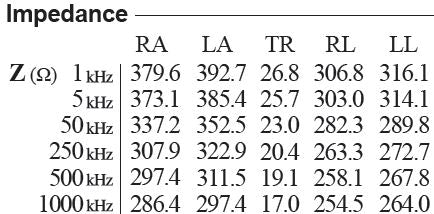
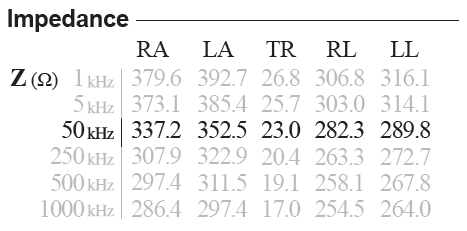
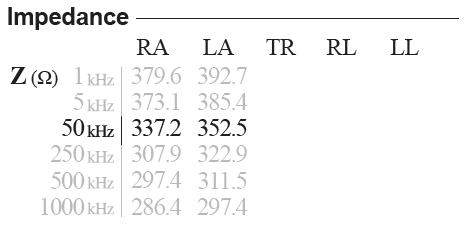
All BIA devices use at least one electric current set at a specific frequency to measure body composition.  In the past, this frequency was traditionally set at 50 kHz.  Some devices today continue to use this single frequency.

However, beginning the early 1990s, research began to accumulate suggesting that single frequency devices set at 50 kHz did not accurately predict changes in total body water, and that the use of multiple frequencies – multiple currents set at a different frequencies – was a superior method in terms of accuracy.  So, the first thing you will want to check when looking at BIA devices whether it is a single or multifrequency device because generally speaking, devices that use multiple frequencies are found to be more accurate.

Why are multifrequency devices typically more accurate?  The answer lies with how BIA devices measure that resistance – more accurately termed “impedance” – when the current travels through the body.

As the current travels, the water in your body will naturally resist the flow of the current as it travels.  This is called resistance.  When the current encounters a cell, the cell wall will cause a “delay” as the current builds up enough energy to pass through the cell wall.  This brief “time delay” is referred to as reactance.  Impedance is a combination of these two values.

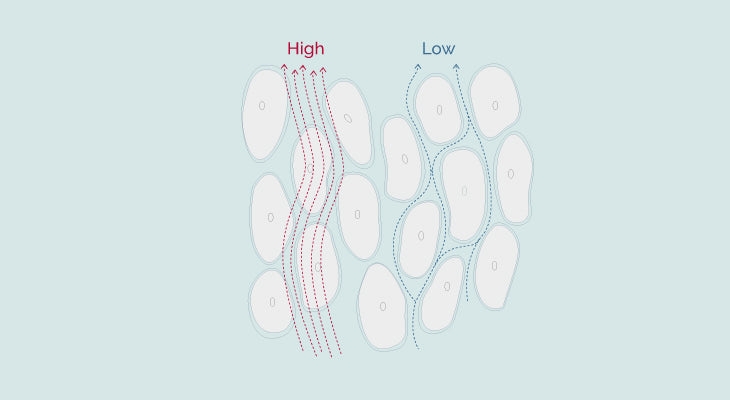
How does this apply to frequencies? Lower frequencies don’t have enough energy to pass through cell walls easily, so they often follow an easier path by traveling around cells. This means lower frequencies are better suited for measuring extracellular water.  Conversely, higher frequencies are better suited to penetrating cell walls and can measure both intracellular and extracellular water. The end result is that those frequencies can measure all of your body water and provide you with an accurate result for your lean body mass.

Ideally, you will want a device that uses at least two frequencies – one on the lower end and the other on the higher end. The more frequencies you have, the better the device is able to gather the information required to accurately measure your total body water, and from there, your body composition.

See what outputs it provides

BIA devices range widely in capabilities and the outputs they are able to produce.  Some devices only measure your body fat percentage, while others can give much more information.  Typically, the better quality the BIA device, the more comprehensive outputs you will receive.

Every BIA device on the market will at least give body fat percentage.  Using body fat percentage as an indicator of your overall health and weight is a very useful metric and a much better tool than simply monitoring your scale weight.

However, just as relying solely on scale weight isn’t advisable, neither is relying solely on body fat percentage.  This is because body fat percentages can fluctuate for many reasons, not all of these changes are related to weight gain or loss.

Here are a few other BIA outputs to look for and some reasons why you would want to track these in addition to body fat:

  • Skeletal Muscle Mass: Skeletal Muscle Mass is the muscle that you can grow and develop through exercise and proper nutrition.  It also has a significant influence on change in Lean Body Mass.  However, Lean Body Mass can also be influenced by other factors such as body water. If you are tracking Skeletal Muscle Mass, you’ll be able to cross reference your muscle gains against your Lean Body Mass to ensure that those gains are due to muscle, not water.
  • Body Water Analysis: Since BIA devices all measure total body water via impedance, if your device can give you this information, you’ll know how much total body water you have.  If your device can further break this down into intracellular and extracellular water components, you’ll be able to understand your body water levels are properly balanced.  With that information, you’ll know if you have any unusual swelling due to inflammation, injury, etc.
  • Phase Angle: Phase Angle is a measurement of the relationship between reactance, resistance, and impedance.  It’s able to give you an idea of the integrity of your cell walls, which gives an indication of their ability to retain water.  This has an impact on your overall health.  By tracking Phase Angle, you’ll be able to get an idea about the health of your individual cells and how much water is inside them.

Find out what information it needs (important)

All BIA devices are going to require your weight at the very minimum.  For this reason, many BIA devices take the form of bathroom scales.  These devices measure your weight and calculate your body composition results using your weight at the time of testing.

However, not all BIA devices are scales.  BIA technology is being used in handheld devices for convenience, as well as devices that use adhesive electrodes and require a person to lie down while testing.  These types of devices will require a user to enter in their weight manually.  However, unless you weigh yourself right before testing, this information would have to be estimated based on your memory, which could cause inaccurate results.

Another fairly common user input requirement is age or gender.  However, these requirements aren’t to personalize your results; they’re to tell the device which equations to use to calculate your results.  In the BIA industry, these equations are known as empirically derived prediction variables – also sometimes referred to as “empirical estimations.”

For example, the average person tends to gain body fat mass as they age.  This trend has been observed over time, and equations have been developed to account for this fat gain.  By entering in your age, the BIA device will compare the raw data it gets from you and adjust it based on the data it has for your age.

BIA devices often use empirical estimations to improve the accuracy of their results.  They work on the basis of adjusting the raw results for an individual of your age and gender.  Age and gender are common to nearly all BIA devices.

Height is also a common requirement for many BIA devices. It’s an unbiased physical attribute, just like weight.  Unlike age and gender, however, height is necessary not because adjustments need to be made to results, but instead to give the BIA device a frame to understand the impedance results.

Impedance increases as height increases because the current has to physically travel further and will encounter more resistance.  However, high impedance is also associated with a greater proportion of fat mass to lean body mass.  With accurate height measurements, the BIA device will understand how to interpret the impedance values correctly, which is why nearly all BIA devices require height measurements.

Understand what’s measured and what’s not

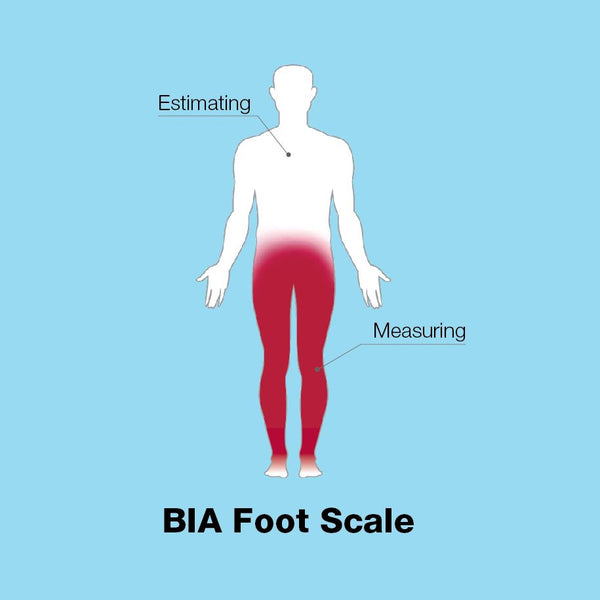
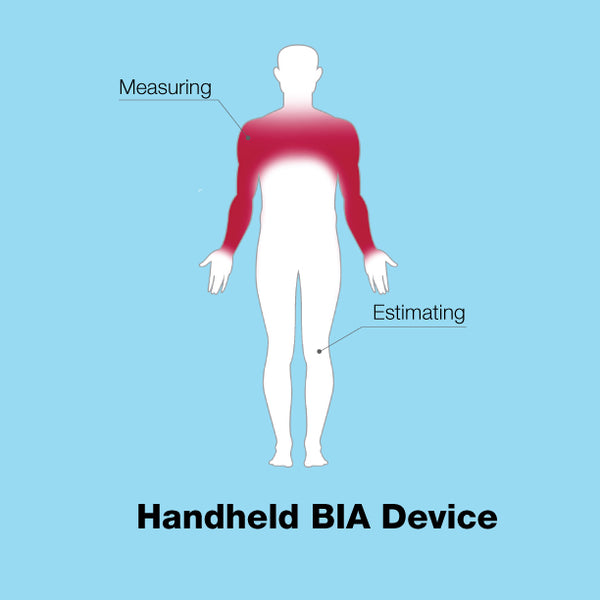
The design of many BIA devices are such that impedance is measured for a certain section of the body, and the results of that section are used to estimate the remaining sections of the body.  Before choosing a BIA device, you should know what exactly your device is measuring and what it is estimating.

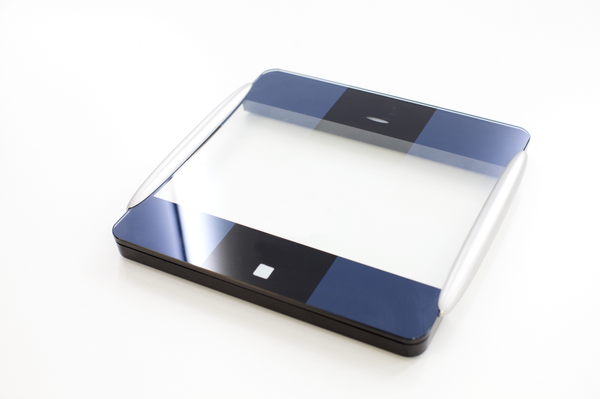
Home scales that use BIA technology to determine body composition operate by sending currents up one leg and down the other.  Impedance is only actually measured for the legs.  In order to calculate the upper body, the device will make assumptions about the composition of your body based on the composition of your legs (and if using age and gender data, adjusting for those as well).

Handheld BIA devices only measure impedance in the arms and upper body.  Similar to how the legs are measured, these types of BIA devices will estimate the lower half of the body with the results from the upper body.

Other devices that use the “Whole Body” impedance use a method that is somewhat misleading.  Unlike scales and handheld devices, the current does travel through the entire body in the sense that it travels from through both the upper and lower body.  However, “Whole Body” impedance devices do not actually directly measure the entire body.  Typically, “Whole Body” impedance devices get most of their measurement data from the arm and leg that the electrodes are placed on.  Just like handhelds and scales, these devices must estimate results for the rest of the body.

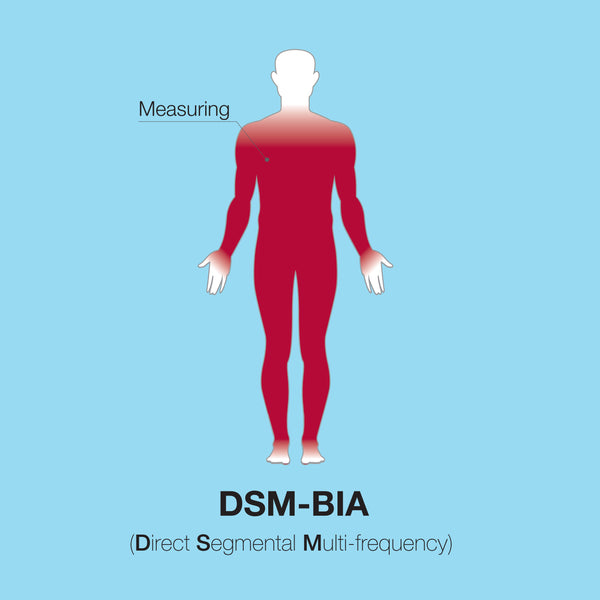
Finally, there are devices that use Direct Segmental Multifrequency-BIA technology (DSM-BIA).  These devices programmed in such a way that they analyze your body in five distinct sections – the two arms, the two legs, and the torso.

Each of these sections is analyzed independently, and from these, a measurement for the entire body is produced.  This is similar to how DEXA machines operate, and when compared against DEXA results, DSM-BIA technology was found to be accurate.  In comparison to other BIA methods, DSM-BIA offers results that are based on direct measurements, without using estimations to compensate for the areas that were not directly measured.

Summary

There are a lot of things to consider when looking for a BIA device.  When you’re assessing which device to go with, it will help you to remember the following:

  • Accuracy generally will increase with multi-frequency devices.  You’ll want at least two frequencies for reliable measurements.
  • You can do more with more results. Changes in body fat percentages can be tricky to explain if the only outputs you have are Fat and Fat Free Mass.
  • Check what information the device needs from you in order to test.  If it requires your age and/or gender, it may be giving you estimations based on the results of the general population.
  • Understand what the device is actually measuring and what it is estimating.  If accuracy is important to you, you’ll want as much of the body measured as possible.

Source: https://uk.inbody.com/blog/a-guide-to-buying-your-first-bia-device/

A Guide to Buying Your First BIA Device

By BIA

People are finally taking notice: body composition is useful for measuring health; BMI is not.  Even the New York Times is publishing stories about the pitfalls and inaccurate uses of BMI.  The jury is in: if you want to be on the cutting edge of health and fitness, you need to be involved with body composition analysis. To do that, you need a device that measures body composition, and some of the most popular body composition tools are devices that use bioelectrical impedance analysis (BIA).

BIA devices are becoming one of the most popular and convenient ways to measure body fat percentage and body composition because of their speed, convenience, and accuracy. There is no shortage of them to buy, and costs range greatly.  Some are under $50, while others range in the tens of thousands.

Why?  What’s the difference between them?

Fundamentally, all BIA devices operate using the same method: a small, safe, electric current is sent through a person’s body.  Along the way, it encounters resistance due to the variation in water content in different parts of your body – like in fat and muscle – and that resistance is measured.  This information is then analyzed and translated into useful outputs, such as body fat percentage and lean body mass.

So if every device uses the same method, why the range in price? What are some things to consider when looking for a BIA device, especially those that influence the cost? Here, we’ll break down the most important things to look into when buying a BIA device to measure body composition.

Check the frequencies

All BIA devices use at least one electric current set at a specific frequency to measure body composition.  In the past, this frequency was traditionally set at 50 kHz.  Some devices today continue to use this single frequency.

However, beginning the early 1990s, research began to accumulate suggesting that single frequency devices set at 50 kHz did not accurately predict changes in total body water, and that the use of multiple frequencies – multiple currents set at a different frequencies – was a superior method in terms of accuracy.  So, the first thing you will want to check when looking at BIA devices whether it is a single or multifrequency device because generally speaking, devices that use multiple frequencies are found to be more accurate.

Why are multifrequency devices typically more accurate?  The answer lies with how BIA devices measure that resistance – more accurately termed “impedance” – when the current travels through the body.

As the current travels, the water in your body will naturally resist the flow of the current as it travels.  This is called resistance.  When the current encounters a cell, the cell wall will cause a “delay” as the current builds up enough energy to pass through the cell wall.  This brief “time delay” is referred to as reactance.  Impedance is a combination of these two values.

How does this apply to frequencies? Lower frequencies don’t have enough energy to pass through cell walls easily, so they often follow an easier path by traveling around cells. This means lower frequencies are better suited for measuring extracellular water.  Conversely, higher frequencies are better suited to penetrating cell walls and can measure both intracellular and extracellular water. The end result is that those frequencies can measure all of your body water and provide you with an accurate result for your lean body mass.

Ideally, you will want a device that uses at least two frequencies – one on the lower end and the other on the higher end. The more frequencies you have, the better the device is able to gather the information required to accurately measure your total body water, and from there, your body composition.

See what outputs it provides

BIA devices range widely in capabilities and the outputs they are able to produce.  Some devices only measure your body fat percentage, while others can give much more information.  Typically, the better quality the BIA device, the more comprehensive outputs you will receive.

Every BIA device on the market will at least give body fat percentage.  Using body fat percentage as an indicator of your overall health and weight is a very useful metric and a much better tool than simply monitoring your scale weight.

However, just as relying solely on scale weight isn’t advisable, neither is relying solely on body fat percentage.  This is because body fat percentages can fluctuate for many reasons, not all of these changes are related to weight gain or loss.

Here are a few other BIA outputs to look for and some reasons why you would want to track these in addition to body fat:

  • Skeletal Muscle Mass: Skeletal Muscle Mass is the muscle that you can grow and develop through exercise and proper nutrition.  It also has a significant influence on change in Lean Body Mass.  However, Lean Body Mass can also be influenced by other factors such as body water. If you are tracking Skeletal Muscle Mass, you’ll be able to cross reference your muscle gains against your Lean Body Mass to ensure that those gains are due to muscle, not water.
  • Body Water Analysis: Since BIA devices all measure total body water via impedance, if your device can give you this information, you’ll know how much total body water you have.  If your device can further break this down into intracellular and extracellular water components, you’ll be able to understand your body water levels are properly balanced.  With that information, you’ll know if you have any unusual swelling due to inflammation, injury, etc.
  • Phase Angle: Phase Angle is a measurement of the relationship between reactance, resistance, and impedance.  It’s able to give you an idea of the integrity of your cell walls, which gives an indication of their ability to retain water.  This has an impact on your overall health.  By tracking Phase Angle, you’ll be able to get an idea about the health of your individual cells and how much water is inside them.

Find out what information it needs (important)

All BIA devices are going to require your weight at the very minimum.  For this reason, many BIA devices take the form of bathroom scales.  These devices measure your weight and calculate your body composition results using your weight at the time of testing.

However, not all BIA devices are scales.  BIA technology is being used in handheld devices for convenience, as well as devices that use adhesive electrodes and require a person to lie down while testing.  These types of devices will require a user to enter in their weight manually.  However, unless you weigh yourself right before testing, this information would have to be estimated based on your memory, which could cause inaccurate results.

Another fairly common user input requirement is age or gender.  However, these requirements aren’t to personalize your results; they’re to tell the device which equations to use to calculate your results.  In the BIA industry, these equations are known as empirically derived prediction variables – also sometimes referred to as “empirical estimations.”

For example, the average person tends to gain body fat mass as they age.  This trend has been observed over time, and equations have been developed to account for this fat gain.  By entering in your age, the BIA device will compare the raw data it gets from you and adjust it based on the data it has for your age.

BIA devices often use empirical estimations to improve the accuracy of their results.  They work on the basis of adjusting the raw results for an individual of your age and gender.  Age and gender are common to nearly all BIA devices.

Height is also a common requirement for many BIA devices. It’s an unbiased physical attribute, just like weight.  Unlike age and gender, however, height is necessary not because adjustments need to be made to results, but instead to give the BIA device a frame to understand the impedance results.

Impedance increases as height increases because the current has to physically travel further and will encounter more resistance.  However, high impedance is also associated with a greater proportion of fat mass to lean body mass.  With accurate height measurements, the BIA device will understand how to interpret the impedance values correctly, which is why nearly all BIA devices require height measurements.

Understand what’s measured and what’s not

The design of many BIA devices are such that impedance is measured for a certain section of the body, and the results of that section are used to estimate the remaining sections of the body.  Before choosing a BIA device, you should know what exactly your device is measuring and what it is estimating.

Home scales that use BIA technology to determine body composition operate by sending currents up one leg and down the other.  Impedance is only actually measured for the legs.  In order to calculate the upper body, the device will make assumptions about the composition of your body based on the composition of your legs (and if using age and gender data, adjusting for those as well).

Handheld BIA devices only measure impedance in the arms and upper body.  Similar to how the legs are measured, these types of BIA devices will estimate the lower half of the body with the results from the upper body.

Other devices that use the “Whole Body” impedance use a method that is somewhat misleading.  Unlike scales and handheld devices, the current does travel through the entire body in the sense that it travels from through both the upper and lower body.  However, “Whole Body” impedance devices do not actually directly measure the entire body.  Typically, “Whole Body” impedance devices get most of their measurement data from the arm and leg that the electrodes are placed on.  Just like handhelds and scales, these devices must estimate results for the rest of the body.

Finally, there are devices that use Direct Segmental Multifrequency-BIA technology (DSM-BIA).  These devices programmed in such a way that they analyze your body in five distinct sections – the two arms, the two legs, and the torso.

Each of these sections is analyzed independently, and from these, a measurement for the entire body is produced.  This is similar to how DEXA machines operate, and when compared against DEXA results, DSM-BIA technology was found to be accurate.  In comparison to other BIA methods, DSM-BIA offers results that are based on direct measurements, without using estimations to compensate for the areas that were not directly measured.

Summary

There are a lot of things to consider when looking for a BIA device.  When you’re assessing which device to go with, it will help you to remember the following:

  • Accuracy generally will increase with multi-frequency devices.  You’ll want at least two frequencies for reliable measurements.
  • You can do more with more results. Changes in body fat percentages can be tricky to explain if the only outputs you have are Fat and Fat Free Mass.
  • Check what information the device needs from you in order to test.  If it requires your age and/or gender, it may be giving you estimations based on the results of the general population.
  • Understand what the device is actually measuring and what it is estimating.  If accuracy is important to you, you’ll want as much of the body measured as possible.

Source: https://uk.inbody.com/blog/a-guide-to-buying-your-first-bia-device/

How to Start Changing Your Body Composition, Today

By Uncategorised

If you’re reading this, then somewhere in your mind you’ve already made the decision to change your life for the better. That’s great!  Making the decision to improve your life in a healthy and positive way is half the battle.

Many people start off with a simple weight loss goal like: “I want to lose 10 pounds.”  That’s a great goal, but unfortunately, it’s a little too vague.  10 pounds…of what? Fat?  If yes, how will you know when you’ve hit that goal?  By standing on a scale?  Even if you see your weight decrease by 10 pounds, how can you be sure that 10 pounds is all fat?  The truth is: you can’t.

Instead of focusing on trying to change your weight, focus on changing your body composition.  This is a different way of thinking about getting fit or losing weight, but it’s a much better way.  It will free you from worrying about your weight on the scale, make your clothes fit better, and have you looking fitter faster than you thought possible.

To change your body composition, you won’t have one goal (like “lose weight” or “gain muscle”). You will have two:

  • Reduce Fat Mass
  • Increase Lean Body Mass

If you’re a bit unclear on terms like “Fat Mass” and “Lean Body Mass,” check out this guide to body composition to help you get up to speed.

By working towards these goals, you’re setting yourself up for long-term success. You’ll be on the path to changing your body for the future, which means you’ll keep the weight off and the muscle on.

To start changing your body composition today, follow these 5 steps. You’ll be glad you did.

1. Get Your Body Fat Percentage Measured

woman testing on inbody 770This is the most important step.  You must get your body composition tested, and you must commit to judging your progress by your body composition results – not what your weight is on the scale.  This means focusing on your body fat percentage instead of your weight.  By determining your progress with useful metrics like this and lean body mass, you will be equipped with the knowledge you need to get the results you want faster and smarter.

One of the quickest and easiest methods to determine body composition and find numbers like body fat percentage is to use a device that uses BIA technology.  For many years, these devices weren’t accurate enough to give reliable body fat percentage results, but that has changed in recent years.

Depending on how you determine body fat, you may get a complete readout of your body with muscle mass, fat mass, body water, etc., or you may just get a body fat percentage.  Try to get as much information as possible using the best tests available so you can plan out your goals properly.

2. Choose a Goal to Work on First

Now that you’re working with two goals instead of one, it’s best to target them one at a time.  Although building Lean Body Mass can go hand in hand with reducing Fat Mass to a certain degree, to reach your goals faster, it’s usually best to target one goal at a time.  This is because your body responds differently to programs that target fat and to those that are designed to build lean muscle.
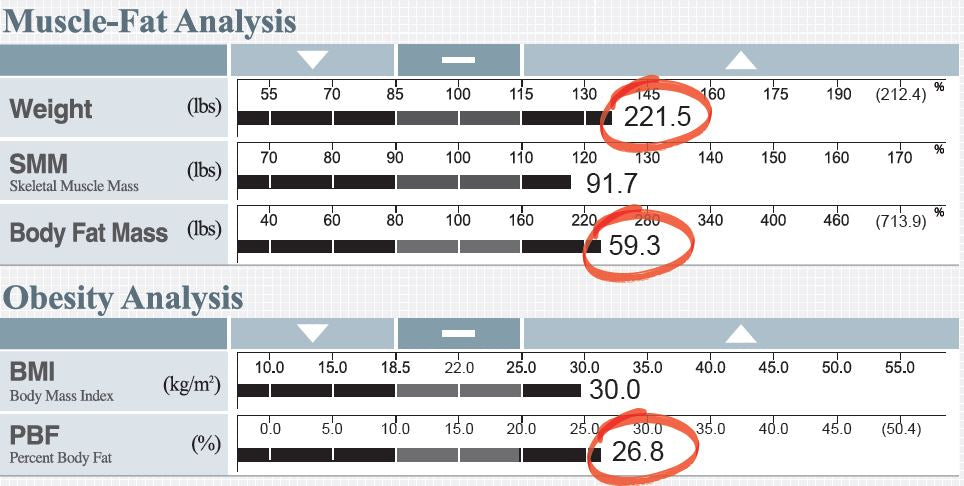
Here’s how to decide which goal to begin with:

  • Fat Loss First

This goal is best for people whose body compositions have two characteristics: high body fat percentage and high overall weight.  For men, this means body fat percentages in the upper 20s, 30s, and above; for women, body fat percentages in mid 30s and above.  Here’s what this can look like (male test subject):

  • Develop Lean Body Mass First

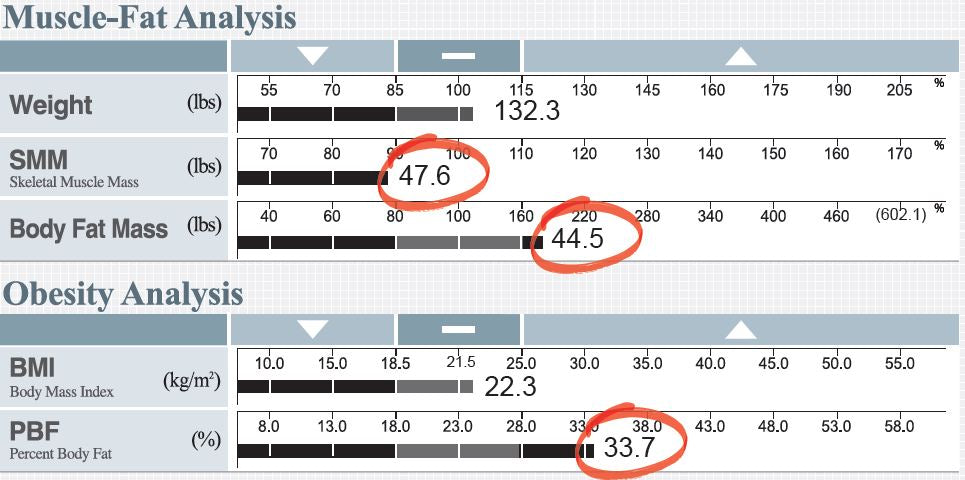
You may want to start by increasing your Lean Body Mass if you are skinny fat. You may be skinny fat if you aren’t overweight but have low amounts of Lean Body Mass and high amounts of Fat Mass.  Here’s an example of what that can look like (female test subject):

Notice how the overall weight, 132.3, does not fall in the overweight range (up arrow), but that the Skeletal Muscle Mass falls under it (down arrow) while the Body Fat Mass is over. Because someone with a body composition like this has less than the recommended levels of Skeletal Muscle Mass, it’s a good idea to start with increasing Lean Body Mass before targeting Fat Mass.

Fortunately, if you start resistance training to build muscle, this will likely bring down your Fat Mass as well.  Increasing your Lean Body Mass will increase the calorie need your body will have in order to maintain itself, and this increased caloric need can lead to your body getting energy by burning some of that extra fat.  The calories you burn in resistance training will also speed up fat loss.

Having enough Lean Body Mass is important for many reasons, including increased strength and increased function of your immune system.  Skeletal Muscle Mass composes the majority of your Lean Body Mass, so increased LBM will also improve your musculature and make you look stronger and more toned.

 3. Choose a Health Plan to Reach Your Goal

Once you’ve decided which goal to work on first, you will need to choose a plan to help you meet that goal.  Although everyone’s individual needs will be different, you can use the following to help build a general plan that you can modify later once you understand how your own body responds to diet and exercise.

  • Targeting Fat Loss

The basic principle behind fat loss is deceptively simple: according to the Center for Disease Control, it’s all about burning more calories in a day than you take in.  This is referred to as maintaining a “caloric deficit.”

You can achieve a caloric deficit in two ways: calorie restriction and exercise.  By taking in less calories than you typically do, your body will respond by finding the calories it needs from your fat mass since it no longer is getting those calories from food and drink.  Many products today are marketed as “fat-free” in order to help people trying to lose weight to make healthy choices. But as it turns out, overall calorie reduction can be more effective than just cutting fat out of your diet, particularly since fat plays a significant role in cell health and metabolism.

You can further increase your caloric deficit through exercise.  Both resistance training and cardiovascular exercise will cause your body to use more calories than you did before beginning training.  Both types of training will play different roles in meeting your goal.

Although some people might discount the importance of resistance training or weightlifting in a fat burning program, to completely ignore this type of exercise is misguided.  Resistance training is very important because it can help you maintain your existing Lean Body Mass and ensure that it doesn’t decrease along with your fat.  Increased Lean Body Mass is linked to higher overall calorie needs, and the more calories you require, the more you weight you stand to lose.

It is true, however, that cardio is important for creating a caloric deficit.  How many calories you stand to burn depend on the type of exercise, duration, and intensity and you may need to find an intersection of the three that works best for you.

  • Building Lean Body Mass

It’s helpful to understand what Lean Body Mass is so you can understand how you can go about developing it.

Lean Body Mass is your total weight minus your fat.  This includes all the weight due to your muscles, organs, and total body water.  You can’t develop your organs, but you can develop your muscles.  The best way to develop your muscles – and thereby your Lean Body Mass – is to adopt a resistance training program.

As you develop stronger muscles, the size and amount of your muscle cells will increase.  Your muscles will require more water – more intracellular water, to be specific – which will allow them to function properly.  As your muscles grow and take in more water, your Lean Body Mass will increase.

 4. Retest to Track Your Progress Towards Your Goal

After a month or two, it will be time to get your body composition tested again.  Resist the temptation to measure yourself for at least a month; it is going to take some time for your body to respond to the diet and exercise changes that you’ve made.

Since you will be measuring your body composition, you should be less interested in your overall weight and more about your body fat percentage and Lean Body Mass.  These will become the most important numbers you will use to determine the success of your program by.

After a month, you should begin to see changes in your body fat percentage regardless of if you decided to focus on fat or lean mass.  If your weight drops due to fat loss while you maintain your Lean Body Mass, your body fat percentage will drop.

Conversely, if your weight stays the same or even increases due to Lean Body Mass, this means that you’ve gained Skeletal Muscle Mass and potentially lost some fat mass too.

If you see a rise in your BMI, that is not a bad thing.  BMI is just a mathematical ratio of your height to weight, and remember, you if your thinking in terms of body composition, simple weight measurements aren’t important anymore.  What’s important is seeing drops in body fat percentage and increases in Lean Body Mass.

If you are hitting your goals after a month, great! If not, you may need to adjust the diet and exercise plans you have set for yourself.  If you aren’t seeing any drops in fat mass after a month, you may need to consider increasing your caloric deficit.  If you aren’t gaining lean mass at the rate you would like, you may need to adjust your calorie intake, your protein intake, or modify resistance training program you’ve adopted.  Then, after another month or two, retest.

5. Be Patient And Reach Your Goal!

Changing your body composition is going to take time, and it is going to take some serious effort.  However, the rewards will be great because the changes you make will last.

While you are putting in the hard work, something to avoid is weighing yourself every day.  Because you’re tracking your body composition/body fat percentage, weighing yourself on a normal scale is going to be less and less useful for you – particularly if you started changing your body composition by building Lean Body Mass.  In that situation, because you’re trying to gain weight due to muscle, you may not register any weight gain at all as the weight due to muscle gain will replace the weight due to the fat you’re losing.

You may find that you even gain overall weight, but as long as that weight is due to muscle, you’ll actually appear thinner.  This is because muscle is much denser than fat.

As you continue to see results, you may find that your goals change over time.  You may find that you have lost a significant amount of fat and would like to rebuild yourself with more muscle.  Conversely, you may become satisfied with the amount of Lean Body Mass you have and start focusing on losing fat to build a lean physique.

Whatever your goals are, the key is to make smart decisions.  By committing to assessing yourself by testing your body composition, you will have the tools and the information to make those smart decisions.  If you are gaining Lean Body Mass, you’ll know.  If you’re losing fat, you’ll know.  Body composition assessments take the guesswork out of getting healthy.  So go out, be smarter, and start building a better you today.

How to Start Changing Your Body Composition, Today

By Body Composition

If you’re reading this, then somewhere in your mind you’ve already made the decision to change your life for the better. That’s great!  Making the decision to improve your life in a healthy and positive way is half the battle.

Many people start off with a simple weight loss goal like: “I want to lose 10 pounds.”  That’s a great goal, but unfortunately, it’s a little too vague.  10 pounds…of what? Fat?  If yes, how will you know when you’ve hit that goal?  By standing on a scale?  Even if you see your weight decrease by 10 pounds, how can you be sure that 10 pounds is all fat?  The truth is: you can’t.

Instead of focusing on trying to change your weight, focus on changing your body composition.  This is a different way of thinking about getting fit or losing weight, but it’s a much better way.  It will free you from worrying about your weight on the scale, make your clothes fit better, and have you looking fitter faster than you thought possible.

To change your body composition, you won’t have one goal (like “lose weight” or “gain muscle”). You will have two:

  • Reduce Fat Mass
  • Increase Lean Body Mass

If you’re a bit unclear on terms like “Fat Mass” and “Lean Body Mass,” check out this guide to body composition to help you get up to speed.

By working towards these goals, you’re setting yourself up for long-term success. You’ll be on the path to changing your body for the future, which means you’ll keep the weight off and the muscle on.

To start changing your body composition today, follow these 5 steps. You’ll be glad you did.

1. Get Your Body Fat Percentage Measured

woman testing on inbody 770This is the most important step.  You must get your body composition tested, and you must commit to judging your progress by your body composition results – not what your weight is on the scale.  This means focusing on your body fat percentage instead of your weight.  By determining your progress with useful metrics like this and lean body mass, you will be equipped with the knowledge you need to get the results you want faster and smarter.

One of the quickest and easiest methods to determine body composition and find numbers like body fat percentage is to use a device that uses BIA technology.  For many years, these devices weren’t accurate enough to give reliable body fat percentage results, but that has changed in recent years.

Depending on how you determine body fat, you may get a complete readout of your body with muscle mass, fat mass, body water, etc., or you may just get a body fat percentage.  Try to get as much information as possible using the best tests available so you can plan out your goals properly.

2. Choose a Goal to Work on First

Now that you’re working with two goals instead of one, it’s best to target them one at a time.  Although building Lean Body Mass can go hand in hand with reducing Fat Mass to a certain degree, to reach your goals faster, it’s usually best to target one goal at a time.  This is because your body responds differently to programs that target fat and to those that are designed to build lean muscle.

Here’s how to decide which goal to begin with:

  • Fat Loss First

This goal is best for people whose body compositions have two characteristics: high body fat percentage and high overall weight.  For men, this means body fat percentages in the upper 20s, 30s, and above; for women, body fat percentages in mid 30s and above.  Here’s what this can look like (male test subject):

  • Develop Lean Body Mass First

You may want to start by increasing your Lean Body Mass if you are skinny fat. You may be skinny fat if you aren’t overweight but have low amounts of Lean Body Mass and high amounts of Fat Mass.  Here’s an example of what that can look like (female test subject):

Notice how the overall weight, 132.3, does not fall in the overweight range (up arrow), but that the Skeletal Muscle Mass falls under it (down arrow) while the Body Fat Mass is over. Because someone with a body composition like this has less than the recommended levels of Skeletal Muscle Mass, it’s a good idea to start with increasing Lean Body Mass before targeting Fat Mass.

Fortunately, if you start resistance training to build muscle, this will likely bring down your Fat Mass as well.  Increasing your Lean Body Mass will increase the calorie need your body will have in order to maintain itself, and this increased caloric need can lead to your body getting energy by burning some of that extra fat.  The calories you burn in resistance training will also speed up fat loss.

Having enough Lean Body Mass is important for many reasons, including increased strength and increased function of your immune system.  Skeletal Muscle Mass composes the majority of your Lean Body Mass, so increased LBM will also improve your musculature and make you look stronger and more toned.

 3. Choose a Health Plan to Reach Your Goal

Once you’ve decided which goal to work on first, you will need to choose a plan to help you meet that goal.  Although everyone’s individual needs will be different, you can use the following to help build a general plan that you can modify later once you understand how your own body responds to diet and exercise.
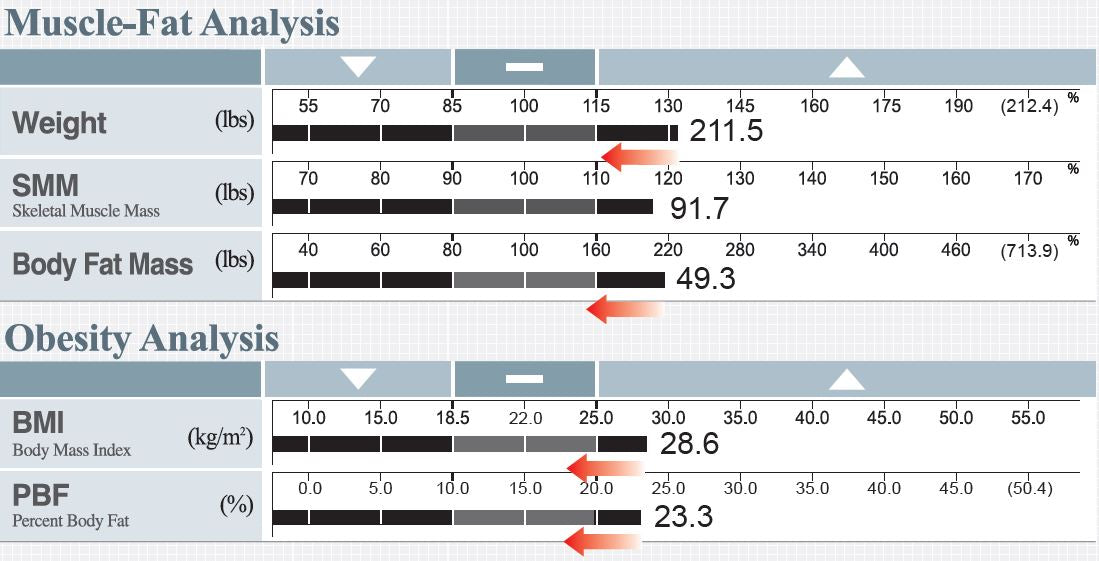
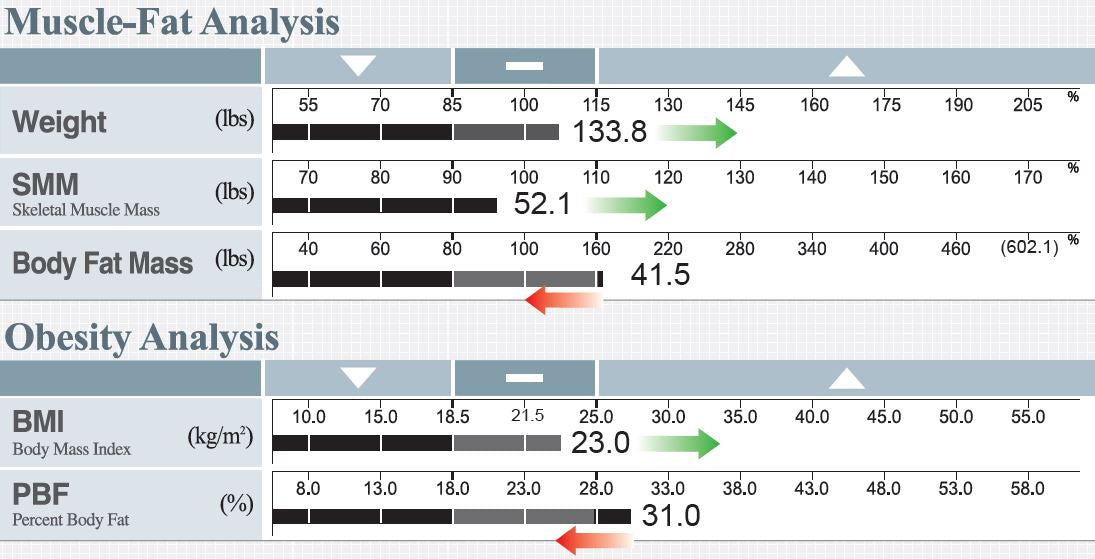
  • Targeting Fat Loss

The basic principle behind fat loss is deceptively simple: according to the Center for Disease Control, it’s all about burning more calories in a day than you take in.  This is referred to as maintaining a “caloric deficit.”

You can achieve a caloric deficit in two ways: calorie restriction and exercise.  By taking in less calories than you typically do, your body will respond by finding the calories it needs from your fat mass since it no longer is getting those calories from food and drink.  Many products today are marketed as “fat-free” in order to help people trying to lose weight to make healthy choices. But as it turns out, overall calorie reduction can be more effective than just cutting fat out of your diet, particularly since fat plays a significant role in cell health and metabolism.

You can further increase your caloric deficit through exercise.  Both resistance training and cardiovascular exercise will cause your body to use more calories than you did before beginning training.  Both types of training will play different roles in meeting your goal.

Although some people might discount the importance of resistance training or weightlifting in a fat burning program, to completely ignore this type of exercise is misguided.  Resistance training is very important because it can help you maintain your existing Lean Body Mass and ensure that it doesn’t decrease along with your fat.  Increased Lean Body Mass is linked to higher overall calorie needs, and the more calories you require, the more you weight you stand to lose.

It is true, however, that cardio is important for creating a caloric deficit.  How many calories you stand to burn depend on the type of exercise, duration, and intensity and you may need to find an intersection of the three that works best for you.

  • Building Lean Body Mass

It’s helpful to understand what Lean Body Mass is so you can understand how you can go about developing it.

Lean Body Mass is your total weight minus your fat.  This includes all the weight due to your muscles, organs, and total body water.  You can’t develop your organs, but you can develop your muscles.  The best way to develop your muscles – and thereby your Lean Body Mass – is to adopt a resistance training program.

As you develop stronger muscles, the size and amount of your muscle cells will increase.  Your muscles will require more water – more intracellular water, to be specific – which will allow them to function properly.  As your muscles grow and take in more water, your Lean Body Mass will increase.

 4. Retest to Track Your Progress Towards Your Goal

After a month or two, it will be time to get your body composition tested again.  Resist the temptation to measure yourself for at least a month; it is going to take some time for your body to respond to the diet and exercise changes that you’ve made.

Since you will be measuring your body composition, you should be less interested in your overall weight and more about your body fat percentage and Lean Body Mass.  These will become the most important numbers you will use to determine the success of your program by.

After a month, you should begin to see changes in your body fat percentage regardless of if you decided to focus on fat or lean mass.  If your weight drops due to fat loss while you maintain your Lean Body Mass, your body fat percentage will drop.

Conversely, if your weight stays the same or even increases due to Lean Body Mass, this means that you’ve gained Skeletal Muscle Mass and potentially lost some fat mass too.

If you see a rise in your BMI, that is not a bad thing.  BMI is just a mathematical ratio of your height to weight, and remember, you if your thinking in terms of body composition, simple weight measurements aren’t important anymore.  What’s important is seeing drops in body fat percentage and increases in Lean Body Mass.

If you are hitting your goals after a month, great! If not, you may need to adjust the diet and exercise plans you have set for yourself.  If you aren’t seeing any drops in fat mass after a month, you may need to consider increasing your caloric deficit.  If you aren’t gaining lean mass at the rate you would like, you may need to adjust your calorie intake, your protein intake, or modify resistance training program you’ve adopted.  Then, after another month or two, retest.

5. Be Patient And Reach Your Goal!

Changing your body composition is going to take time, and it is going to take some serious effort.  However, the rewards will be great because the changes you make will last.

While you are putting in the hard work, something to avoid is weighing yourself every day.  Because you’re tracking your body composition/body fat percentage, weighing yourself on a normal scale is going to be less and less useful for you – particularly if you started changing your body composition by building Lean Body Mass.  In that situation, because you’re trying to gain weight due to muscle, you may not register any weight gain at all as the weight due to muscle gain will replace the weight due to the fat you’re losing.

You may find that you even gain overall weight, but as long as that weight is due to muscle, you’ll actually appear thinner.  This is because muscle is much denser than fat.

As you continue to see results, you may find that your goals change over time.  You may find that you have lost a significant amount of fat and would like to rebuild yourself with more muscle.  Conversely, you may become satisfied with the amount of Lean Body Mass you have and start focusing on losing fat to build a lean physique.

Whatever your goals are, the key is to make smart decisions.  By committing to assessing yourself by testing your body composition, you will have the tools and the information to make those smart decisions.  If you are gaining Lean Body Mass, you’ll know.  If you’re losing fat, you’ll know.  Body composition assessments take the guesswork out of getting healthy.  So go out, be smarter, and start building a better you today.

BIA: Once Flawed, Not Anymore

By Uncategorised

In the world of body composition analysis, bioelectrical impedance analysis (BIA) is almost a dirty word.

Although well-known and popularly used in consumer home/fitness equipment, BIA technology has been disregarded for years when it comes to medical or professional purposes.  And for good reason: many early BIA devices had serious design flaws.  Even today, many people immediately dismiss BIA technology as technology that can only give ballpark estimations, even in the best of circumstances.

However, BIA has come a very long way over the past few decades.  So far, in fact, that some bioelectrical impedance devices are now producing results that nearly mirror results generated by DEXA, an industry-regarded gold standard.

Really? Yes, really.

Imagine if you could determine body composition with a device that used technology which had all the convenience of traditional BIA, but combined it with the precision and reproducibility of a gold standard procedure.  Imagine if that device was small enough to be placed anywhere: a doctor’s office, a gym, even a bedroom.  Imagine if that device could track your results forever and illustrate your progress over time.

Today, devices like these exist.

If you haven’t interacted with BIA technology recently, or the last time you encountered it was in a Fitness Science textbook in a college class years ago, consider this your crash course update on modern, 21st century, BIA technology.

Why BIA Gets a Bad Name

Many of the valid concerns people have about using BIA technology stem from outdated, older technology.  If you’re concerned about the accuracy of BIA devices, you probably have very legitimate reasons.  These devices fall into three general groups:

  1. BIA Scales
  2. Handheld BIA Devices
  3. “Whole Body” Impedance Devices

Let’s look at each one to see what the concerns are and where they come from.

  • BIA Scales

When people think about BIA devices that measure body fat, many of them think about something that looks similar to this:


This is a traditional digital scale that incorporates BIA technology to determine body fat percentage.  To use it, you must enter your age, height, and gender.  Some devices require body type, too. Then, you stand on the scale while it measures your weight.  Once the scale has all the required data, it computes your body fat percentage using BIA technology.

However, the accuracy of such a device has some serious flaws.

First of all, what many people may not realize is BIA scales such as these only send a current up one leg and down the other.  This means that impedance (the metric that all BIA devices use to compute results) is only directly measured in the legs.

The upper body and arms?  Estimated based on the results for the legs.  This means that roughly 40% of your Lean Body Mass is used to determine a body fat percentage that is supposed to account for 100% of your body.

If you feel skeptical about trusting your results from a BIA scale, you’re absolutely correct to do so.

  • Handheld BIA Devices

Handheld BIA devices – such as the ones carried by many gyms – are no better, and due to the relatively smaller size of the arms compared to the legs may actually be even more unreliable.  Those devices operate similarly as BIA scales, except instead of measuring the legs, handheld BIA devices send the current from one arm to the other and then estimate everything from your chest down.

This means that these devices are guessing what your overall body composition is based on the composition of your arms.  This can lead to inaccurate results.  If your arms are the most muscular part of your body but you carry the majority of your fat in your midsection, a handheld BIA device will not be able to account for that.

Because handheld BIA devices don’t just report muscle and fat for the arms and give results for the entire body, these results are not trustworthy. Handheld BIA devices only directly measure the arms. Everything else is just estimation and guesswork.

  • “Whole Body” Impedance Devices

What about conventional BIA devices, the ones that require you to lie down and have a technician attach adhesive electrodes to the whole right side of your body?  Surely those must be accurate.

Just like scales and handhelds, these devices don’t measure the entire body, even though they might appear to do so.  However, instead of completely missing the upper or lower half of the body like BIA scales and handhelds do, these devices operate differently – but are just as flawed.

In the case of conventional BIA devices, four electrodes are placed on the right half of the body.   The current is sent from the arm, through the body, and out through the leg.  This is somewhat misleadingly referred to as the “Whole Body Impedance” method.

Why misleading? Take a look below:

Although “whole body” might suggest that these devices actually measure the whole body, in reality these machines only directly measure approximately half (usually the right side) and then estimate the remainder.

The core problem with these devices is that they treat the entire body as a single “cylinder.”  This means that when the machine is collecting information, it treats your arms in the same way it treats your trunk/torso; never mind that the trunk’s composition is significantly different than an arm (it contains the internal organs, for instance, and contains a greater amount of Lean Body Mass).

This is a problem when measuring fat and muscle.  Although similarities among genders exist, everybody and every body is different.  Men tend to collect the majority of their fat around their abdomen (android obesity), whereas women tend to collect in the arms and legs in addition to their midsections (gynoid obesity).

What would happen if a particular person didn’t conform to these assumptions? False readings and inaccurate results.

The Future: DSM-BIA

For many people, the devices described above are the only BIA devices they are familiar with.  That’s why, including for those described above, people have very good reasons for dismissing BIA technology. 

However, the industry has recognized the flaws in these BIA devices for some time and, in the last few decades, has responded.

Direct Segmental Multi-Frequency Bioelectrical Impedance Analysis (DSM-BIA) is a new, modern approach to BIA technology that, for the first time, directly measures the entire body.

Unlike any of the previous methods or devices above, devices that employ DSM-BIA do not leave any section of the body unaccounted for.  In order to do this accurately, the body is divided into 5 segments and the impedance for each segment is measured independently.

Once the impedance values for each segment are known, the device interprets the raw data and translates it into useful values such as:

  • Body Fat Percentage
  • Total Body Water
  • Lean Body Mass

Because all 5 segments are measured independently of each other, this allows for more advanced analyses.  The below example shows the amount of Lean Body Mass in pounds in each segment of the body:

Using a device that employs DSM-BIA technology allows a doctor, researcher, or fitness professional to paint a more complete picture of a client’s body composition.  It allows each segment of the body to be measured independently, just as DEXA does, but does it much quicker and more conveniently than DEXA –a major advantage of using a BIA device.

Why Trust This Tech?

DSM-BIA represents a major improvement over all previous BIA devices.  But in order to understand this technology and be confident in the results, you’ll need a brief overview on the basics of how BIA devices work.

All BIA devices operate by sending a small electrical current through fluid, which in the human body, is body water.  The current enters and exits via electrodes that come into contact with the skin.  As the current travels throughout your body water, it encounters muscle cells, fat cells, skin cells, etc.  Each of these has a certain ability to oppose the current slightly as it travels on its path towards the exit point.

Once the current finally reaches its endpoint, it will have lost some of its voltage on its journey through body water.  From here, impedance is determined.  BIA devices, including DSM-BIA devices, take impedance values and translate them into useful information that people can readily understand, like Body Fat Percentage and Lean Body Mass.

If all BIA devices use the same basic principle, then what makes DSM-BIA different?

Consider the example of the “Whole Body Impedance” devices.  While on the one hand they appear to be measuring the entire body and delivering trustworthy results, on the other, they treat the body as though it were a single tube of water, irrespective of body shape.  This means that the opposing effect that the current experiences as it travels through the body gets lumped together as a single impedance value.

This is a problem because due to the width of the arms and legs vs. the width of the upper body, impedance values actually vary quite significantly.  Impedance values for the arms and legs can be 10+ times greater than those for the trunk, as shown below (TR = trunk):


As you can see, the values for the trunk are much, much lower than those of the arms and legs.  A “Whole Body” impedance device would have taken all five of these values and lumped them into a single “whole body” result.  This is where Whole Body impedance gets its name and where it gets its inaccuracy.

As for BIA scales and handheld BIA devices?  A BIA scale will produce results that would look like this:


The handheld BIA device will only be able to measure the arms:


You should notice something: neither of them will measure the all-important trunk.  Only devices that use DSM-BIA paint a complete picture, and only DSM-BIA devices will deliver results that stack up against the gold standards.  All other devices can only offer estimations at best.

An Easier, Better, More Accurate Way

DSM-BIA technology represents the future of body composition analysis and BIA technology.  Older BIA devices have major design flaws that limited their reliability and the reproducibility of their results; DSM-BIA technology has responded to those flaws.

By improving BIA technology, DSM-BIA devices blend the precision expected from gold standard devices with the convenience and ease-of-use provided by traditional BIA devices.  It is possible to have the best of both worlds, after all.

Source: https://inbodyusa.com/blogs/inbodyblog/bia-technology/39971073-bia-once-flawed-not-anymore/

BIA: Once Flawed, Not Anymore

By Fat mass, Health

In the world of body composition analysis, bioelectrical impedance analysis (BIA) is almost a dirty word.

Although well-known and popularly used in consumer home/fitness equipment, BIA technology has been disregarded for years when it comes to medical or professional purposes.  And for good reason: many early BIA devices had serious design flaws.  Even today, many people immediately dismiss BIA technology as technology that can only give ballpark estimations, even in the best of circumstances.

However, BIA has come a very long way over the past few decades.  So far, in fact, that some bioelectrical impedance devices are now producing results that nearly mirror results generated by DEXA, an industry-regarded gold standard.

Really? Yes, really.

Imagine if you could determine body composition with a device that used technology which had all the convenience of traditional BIA, but combined it with the precision and reproducibility of a gold standard procedure.  Imagine if that device was small enough to be placed anywhere: a doctor’s office, a gym, even a bedroom.  Imagine if that device could track your results forever and illustrate your progress over time.

Today, devices like these exist.

If you haven’t interacted with BIA technology recently, or the last time you encountered it was in a Fitness Science textbook in a college class years ago, consider this your crash course update on modern, 21st century, BIA technology.

Why BIA Gets a Bad Name

Many of the valid concerns people have about using BIA technology stem from outdated, older technology.  If you’re concerned about the accuracy of BIA devices, you probably have very legitimate reasons.  These devices fall into three general groups:

  1. BIA Scales
  2. Handheld BIA Devices
  3. “Whole Body” Impedance Devices

Let’s look at each one to see what the concerns are and where they come from.

  • BIA Scales

When people think about BIA devices that measure body fat, many of them think about something that looks similar to this:


This is a traditional digital scale that incorporates BIA technology to determine body fat percentage.  To use it, you must enter your age, height, and gender.  Some devices require body type, too. Then, you stand on the scale while it measures your weight.  Once the scale has all the required data, it computes your body fat percentage using BIA technology.

However, the accuracy of such a device has some serious flaws.

First of all, what many people may not realize is BIA scales such as these only send a current up one leg and down the other.  This means that impedance (the metric that all BIA devices use to compute results) is only directly measured in the legs.

The upper body and arms?  Estimated based on the results for the legs.  This means that roughly 40% of your Lean Body Mass is used to determine a body fat percentage that is supposed to account for 100% of your body.

If you feel skeptical about trusting your results from a BIA scale, you’re absolutely correct to do so.

  • Handheld BIA Devices

Handheld BIA devices – such as the ones carried by many gyms – are no better, and due to the relatively smaller size of the arms compared to the legs may actually be even more unreliable.  Those devices operate similarly as BIA scales, except instead of measuring the legs, handheld BIA devices send the current from one arm to the other and then estimate everything from your chest down.

This means that these devices are guessing what your overall body composition is based on the composition of your arms.  This can lead to inaccurate results.  If your arms are the most muscular part of your body but you carry the majority of your fat in your midsection, a handheld BIA device will not be able to account for that.

Because handheld BIA devices don’t just report muscle and fat for the arms and give results for the entire body, these results are not trustworthy. Handheld BIA devices only directly measure the arms. Everything else is just estimation and guesswork.

  • “Whole Body” Impedance Devices

What about conventional BIA devices, the ones that require you to lie down and have a technician attach adhesive electrodes to the whole right side of your body?  Surely those must be accurate.

Just like scales and handhelds, these devices don’t measure the entire body, even though they might appear to do so.  However, instead of completely missing the upper or lower half of the body like BIA scales and handhelds do, these devices operate differently – but are just as flawed.

In the case of conventional BIA devices, four electrodes are placed on the right half of the body.   The current is sent from the arm, through the body, and out through the leg.  This is somewhat misleadingly referred to as the “Whole Body Impedance” method.

Why misleading? Take a look below:

Although “whole body” might suggest that these devices actually measure the whole body, in reality these machines only directly measure approximately half (usually the right side) and then estimate the remainder.

The core problem with these devices is that they treat the entire body as a single “cylinder.”  This means that when the machine is collecting information, it treats your arms in the same way it treats your trunk/torso; never mind that the trunk’s composition is significantly different than an arm (it contains the internal organs, for instance, and contains a greater amount of Lean Body Mass).

This is a problem when measuring fat and muscle.  Although similarities among genders exist, everybody and every body is different.  Men tend to collect the majority of their fat around their abdomen (android obesity), whereas women tend to collect in the arms and legs in addition to their midsections (gynoid obesity).

What would happen if a particular person didn’t conform to these assumptions? False readings and inaccurate results.

The Future: DSM-BIA

For many people, the devices described above are the only BIA devices they are familiar with.  That’s why, including for those described above, people have very good reasons for dismissing BIA technology. 

However, the industry has recognized the flaws in these BIA devices for some time and, in the last few decades, has responded.

Direct Segmental Multi-Frequency Bioelectrical Impedance Analysis (DSM-BIA) is a new, modern approach to BIA technology that, for the first time, directly measures the entire body.

Unlike any of the previous methods or devices above, devices that employ DSM-BIA do not leave any section of the body unaccounted for.  In order to do this accurately, the body is divided into 5 segments and the impedance for each segment is measured independently.

Once the impedance values for each segment are known, the device interprets the raw data and translates it into useful values such as:

  • Body Fat Percentage
  • Total Body Water
  • Lean Body Mass

Because all 5 segments are measured independently of each other, this allows for more advanced analyses.  The below example shows the amount of Lean Body Mass in pounds in each segment of the body:

Using a device that employs DSM-BIA technology allows a doctor, researcher, or fitness professional to paint a more complete picture of a client’s body composition.  It allows each segment of the body to be measured independently, just as DEXA does, but does it much quicker and more conveniently than DEXA –a major advantage of using a BIA device.

Why Trust This Tech?

DSM-BIA represents a major improvement over all previous BIA devices.  But in order to understand this technology and be confident in the results, you’ll need a brief overview on the basics of how BIA devices work.

All BIA devices operate by sending a small electrical current through fluid, which in the human body, is body water.  The current enters and exits via electrodes that come into contact with the skin.  As the current travels throughout your body water, it encounters muscle cells, fat cells, skin cells, etc.  Each of these has a certain ability to oppose the current slightly as it travels on its path towards the exit point.

Once the current finally reaches its endpoint, it will have lost some of its voltage on its journey through body water.  From here, impedance is determined.  BIA devices, including DSM-BIA devices, take impedance values and translate them into useful information that people can readily understand, like Body Fat Percentage and Lean Body Mass.

If all BIA devices use the same basic principle, then what makes DSM-BIA different?

Consider the example of the “Whole Body Impedance” devices.  While on the one hand they appear to be measuring the entire body and delivering trustworthy results, on the other, they treat the body as though it were a single tube of water, irrespective of body shape.  This means that the opposing effect that the current experiences as it travels through the body gets lumped together as a single impedance value.

This is a problem because due to the width of the arms and legs vs. the width of the upper body, impedance values actually vary quite significantly.  Impedance values for the arms and legs can be 10+ times greater than those for the trunk, as shown below (TR = trunk):


As you can see, the values for the trunk are much, much lower than those of the arms and legs.  A “Whole Body” impedance device would have taken all five of these values and lumped them into a single “whole body” result.  This is where Whole Body impedance gets its name and where it gets its inaccuracy.

As for BIA scales and handheld BIA devices?  A BIA scale will produce results that would look like this:


The handheld BIA device will only be able to measure the arms:


You should notice something: neither of them will measure the all-important trunk.  Only devices that use DSM-BIA paint a complete picture, and only DSM-BIA devices will deliver results that stack up against the gold standards.  All other devices can only offer estimations at best.

An Easier, Better, More Accurate Way

DSM-BIA technology represents the future of body composition analysis and BIA technology.  Older BIA devices have major design flaws that limited their reliability and the reproducibility of their results; DSM-BIA technology has responded to those flaws.

By improving BIA technology, DSM-BIA devices blend the precision expected from gold standard devices with the convenience and ease-of-use provided by traditional BIA devices.  It is possible to have the best of both worlds, after all.

Source: https://inbodyusa.com/blogs/inbodyblog/bia-technology/39971073-bia-once-flawed-not-anymore/

BMI’s Fat Secret

By Uncategorised

Let’s say you are an office worker that may have gained a little bit of weight since starting your new job and you want to assess your body weight. If you are like most, you will use the Body Mass Index (BMI), which is commonly used by physicians, insurance companies, and regular people around the world to determine if a person is considered overweight or obese.

BMI scores are calculated from the US National Institute of Health

After you calculate your score, you compare your BMI score against the Body Mass Index ranges set by the World Health Organization.

Source: WHO

Your BMI score of 23.9 falls between 18.5 – 24.9, so you are safe in the normal range. You will take it! But before you celebrate too much, consider this.

Body Mass Index was never intended to be used to measure individuals at all.

Here’s a quote from The World Health Organization

The BMI provides the most useful population-level measure of overweight and obesity, as it is the same for both sexes and for all ages of adults. However, it should be considered as a rough guide because it may not correspond to the same body fat percentage in different individuals.

Despite this clear message, many doctors, physicians, and regular people continue to use BMI as a diagnostic tool simply out of convenience.

However, relying on BMI as your only health indicator can mask your risk for serious health issue because BMI can’t tell the difference between muscle mass and fat, and more importantly where the fat is distributed. You might have unpleasant secret hiding behind that healthy BMI.

Let’s test the same individual using a medical grade body composition analyzer.

Visceral Fat is based on the estimated amount of fat surrounding internal organs in the abdomen. It’s also suggested to maintain a level under 100 cm² to be healthy.

Although a higher than the recommended body fat percentage is what most people (and the media) focus on, this individual’s high visceral fat is actually the worst of the two.  That’s because visceral fat acts like another living organ inside your abdominal cavity.

What is Visceral Fat?

Visceral fat is a special kind of fat that is hidden deep inside your abdomen and surrounds your inner organs. Everyone has some.  Unlike surface level (subcutaneous) fat, it’s not easy to gauge how much visceral fat someone has just by looking at them. That’s because visceral fat is hidden away in the abdominal cavity, in between your organs.

If you rely on BMI as your primary tool to assess weight, you may have significant amounts of visceral fat and not know it.

Unlike the organs that you were born with that sustain life, visceral fat actively works from the inside out to sabotage those organs and ruin your bodily functions.

According to Harvard University, visceral fat secretes a number of hormones and chemicals.  One group of these chemicals is called cytokines. Cytokines play an important role in the human body, but increased levels of cytokines due to excess visceral fat can be problematic. Once cytokines enter the liver, they influence the production of blood lipids, which has been linked to higher cholesterol and insulin resistance. This can lead to Type 2 diabetes.

Type 2 diabetes is typically associated with people who are overweight or obese, and individuals whose BMIs above the normal range (18.5-24.9) are said to be at a significantly greater health risk. However, BMI can misrepresent people who are either near or slightly over the 24.99 mark.

But that’s not all. Individuals with normal BMI but high visceral fat level share similar risk profiles as those who are visibly obese.  Maintaining a high visceral fat can contribute to a myriad of health complications including high blood pressure, heart disease, cancer, and depression.

Depending on lifestyle factors, many people have a body profile like our example: large amounts of abdominal fat, yet a “normal” BMI because they don’t have much skeletal muscle mass. Due to the trend towards sedentary lifestyles, this is becoming more and more common.

The Visceral Fat Recipe

Excess visceral fat is unnecessary fat and develops as a result of having a caloric surplus.  Unsurprisingly, visceral fat develops as a result of adopting unhealthy lifestyle habits.  Some of these factors include:

For people living sedentary lifestyles, it is quite easy to pick up several of these unhealthy habits.  Over time, these habits will lead to increased amounts of body fat, including visceral fat.

Assessing Your Risk

How can you figure out if you have large amounts of visceral fat?  

Here are three options:

1. Waist Measurement

According to the Mayo Clinic, using a measuring tape to measure your waistline is a fairly good way to estimate your visceral fat content.  If your waist measures over 35 inches for women or over 40 inches men, you may be carrying too much visceral fat.

2. Dual Energy X-ray Absorptiometry (DEXA) Scan

Source: Flickr

One of the most precise methods of determining the amount of visceral fat deposits is by taking a DEXA test. But this requires access to a facility that has a unit, and a test can be expensive.

3. Professional Bioelectrical Impedance Analysis (BIA)

A great alternative to a DEXA test may be a medical BIA test.  These tests measure the resistance experienced by an electric current as it travels through your body to determine your body fat percentage, which includes your visceral fat.  Advanced BIA devices that take direct segmental measurements are able to report visceral fat content, although you would need to ensure that the device you are using has this capability.

Knowing your body composition will give you a much better idea about your amount of visceral fat than BMI can.  If your weight and/or BMI is considered “normal,” but your body composition test reveals if you have a high body fat percentage and low muscle mass (as with people who are skinny fat), you might want to consider making some lifestyle changes to reduce your risk of developing potentially serious health complications like heart disease in the future. If your body composition test provides your BMR, use that number to determine your daily calories needs as part of your weight loss strategy.

Conclusion

Hopefully, this clears things up for you. BMI cannot determine if you are lean, overweight, or somewhere in between.  It’s all just raw numbers with BMI.

if you have a “normal” weight and BMI, don’t let your guard down!  It’s easy to just fall into the trap and think “I may be chubbier but I’m not obese so I don’t have to think about weight loss; ” or “I guess I just have good genes so I’m always going to look underweight.”

No one should expect to eat a diet high in calories and saturated fat, totally ignore exercise, and expect to be healthy their entire life.

The good news is, if you exercise, watch your calories,  and live a generally healthy lifestyle, you’re going to avoid gaining too much visceral fat as the result of the good choices you’re making.  Body composition testing will always give you much more information than your BMI ever will, and can give you a much better picture of everything that makes up your weight, including your visceral fat. Remember “what gets measured, gets managed” so go take a body composition test and find out visceral fat level!

Source: https://inbodyusa.com/blogs/inbodyblog/38654081-bmis-fat-secret/

BMI’s Fat Secret

By Press

Let’s say you are an office worker that may have gained a little bit of weight since starting your new job and you want to assess your body weight. If you are like most, you will use the Body Mass Index (BMI), which is commonly used by physicians, insurance companies, and regular people around the world to determine if a person is considered overweight or obese.

BMI scores are calculated from the US National Institute of Health

After you calculate your score, you compare your BMI score against the Body Mass Index ranges set by the World Health Organization.

Source: WHO

Your BMI score of 23.9 falls between 18.5 – 24.9, so you are safe in the normal range. You will take it! But before you celebrate too much, consider this.

Body Mass Index was never intended to be used to measure individuals at all.

Here’s a quote from The World Health Organization

The BMI provides the most useful population-level measure of overweight and obesity, as it is the same for both sexes and for all ages of adults. However, it should be considered as a rough guide because it may not correspond to the same body fat percentage in different individuals.

Despite this clear message, many doctors, physicians, and regular people continue to use BMI as a diagnostic tool simply out of convenience.

However, relying on BMI as your only health indicator can mask your risk for serious health issue because BMI can’t tell the difference between muscle mass and fat, and more importantly where the fat is distributed. You might have unpleasant secret hiding behind that healthy BMI.

Let’s test the same individual using a medical grade body composition analyzer.

Visceral Fat is based on the estimated amount of fat surrounding internal organs in the abdomen. It’s also suggested to maintain a level under 100 cm² to be healthy.

Although a higher than the recommended body fat percentage is what most people (and the media) focus on, this individual’s high visceral fat is actually the worst of the two.  That’s because visceral fat acts like another living organ inside your abdominal cavity.

What is Visceral Fat?

Visceral fat is a special kind of fat that is hidden deep inside your abdomen and surrounds your inner organs. Everyone has some.  Unlike surface level (subcutaneous) fat, it’s not easy to gauge how much visceral fat someone has just by looking at them. That’s because visceral fat is hidden away in the abdominal cavity, in between your organs.

If you rely on BMI as your primary tool to assess weight, you may have significant amounts of visceral fat and not know it.

Unlike the organs that you were born with that sustain life, visceral fat actively works from the inside out to sabotage those organs and ruin your bodily functions.

According to Harvard University, visceral fat secretes a number of hormones and chemicals.  One group of these chemicals is called cytokines. Cytokines play an important role in the human body, but increased levels of cytokines due to excess visceral fat can be problematic. Once cytokines enter the liver, they influence the production of blood lipids, which has been linked to higher cholesterol and insulin resistance. This can lead to Type 2 diabetes.

Type 2 diabetes is typically associated with people who are overweight or obese, and individuals whose BMIs above the normal range (18.5-24.9) are said to be at a significantly greater health risk. However, BMI can misrepresent people who are either near or slightly over the 24.99 mark.

But that’s not all. Individuals with normal BMI but high visceral fat level share similar risk profiles as those who are visibly obese.  Maintaining a high visceral fat can contribute to a myriad of health complications including high blood pressure, heart disease, cancer, and depression.

Depending on lifestyle factors, many people have a body profile like our example: large amounts of abdominal fat, yet a “normal” BMI because they don’t have much skeletal muscle mass. Due to the trend towards sedentary lifestyles, this is becoming more and more common.

The Visceral Fat Recipe

Excess visceral fat is unnecessary fat and develops as a result of having a caloric surplus.  Unsurprisingly, visceral fat develops as a result of adopting unhealthy lifestyle habits.  Some of these factors include:

For people living sedentary lifestyles, it is quite easy to pick up several of these unhealthy habits.  Over time, these habits will lead to increased amounts of body fat, including visceral fat.

Assessing Your Risk

How can you figure out if you have large amounts of visceral fat?  

Here are three options:

1. Waist Measurement

According to the Mayo Clinic, using a measuring tape to measure your waistline is a fairly good way to estimate your visceral fat content.  If your waist measures over 35 inches for women or over 40 inches men, you may be carrying too much visceral fat.

2. Dual Energy X-ray Absorptiometry (DEXA) Scan

Source: Flickr

One of the most precise methods of determining the amount of visceral fat deposits is by taking a DEXA test. But this requires access to a facility that has a unit, and a test can be expensive.

3. Professional Bioelectrical Impedance Analysis (BIA)

A great alternative to a DEXA test may be a medical BIA test.  These tests measure the resistance experienced by an electric current as it travels through your body to determine your body fat percentage, which includes your visceral fat.  Advanced BIA devices that take direct segmental measurements are able to report visceral fat content, although you would need to ensure that the device you are using has this capability.

Knowing your body composition will give you a much better idea about your amount of visceral fat than BMI can.  If your weight and/or BMI is considered “normal,” but your body composition test reveals if you have a high body fat percentage and low muscle mass (as with people who are skinny fat), you might want to consider making some lifestyle changes to reduce your risk of developing potentially serious health complications like heart disease in the future. If your body composition test provides your BMR, use that number to determine your daily calories needs as part of your weight loss strategy.

Conclusion

Hopefully, this clears things up for you. BMI cannot determine if you are lean, overweight, or somewhere in between.  It’s all just raw numbers with BMI.

if you have a “normal” weight and BMI, don’t let your guard down!  It’s easy to just fall into the trap and think “I may be chubbier but I’m not obese so I don’t have to think about weight loss; ” or “I guess I just have good genes so I’m always going to look underweight.”

No one should expect to eat a diet high in calories and saturated fat, totally ignore exercise, and expect to be healthy their entire life.

The good news is, if you exercise, watch your calories,  and live a generally healthy lifestyle, you’re going to avoid gaining too much visceral fat as the result of the good choices you’re making.  Body composition testing will always give you much more information than your BMI ever will, and can give you a much better picture of everything that makes up your weight, including your visceral fat. Remember “what gets measured, gets managed” so go take a body composition test and find out visceral fat level!

Source: https://inbodyusa.com/blogs/inbodyblog/38654081-bmis-fat-secret/